
Routine chlorine testing guarantees disinfectant levels remain effective and safe, preventing microbial growth and limiting excess chemical exposure. It differentiates free chlorine (active disinfectant) from total chlorine (including chloramines) to signal efficacy or byproduct issues. Testing methods range from strips and reagent kits to colorimeters and continuous sensors, chosen by sensitivity and resources Ion Chromatography. Interpreting results guides dosing, shock treatments, or flushing and supports compliance and transparency. More details on methods, thresholds, and plans follow below.

Why Chlorine Testing Keeps Water Safe
Why does routine chlorine testing matter? Routine checks ensure disinfection remains effective without overstepping limits that constrain personal and community choice.
Observers track residual levels to prevent microbial growth while avoiding excess chemical exposure that can restrict uses like gardening, cooking, or recreation https://laballiance.com.my/. Testing supplies objective data, empowering operators and residents to make timely adjustments and maintain transparent control over water treatment decisions.
Regular monitoring also signals infrastructure or contamination issues early, preserving autonomy by preventing sudden, restrictive interventions. Clear records support informed debate about acceptable risk and treatment strategies.
Free vs. Total Chlorine Testing: When to Use
Having established the role of routine chlorine monitoring in balancing safety and personal choice, attention turns to selecting the proper measurement: free chlorine versus total chlorine.
Free chlorine indicates available disinfectant—hypochlorous acid and hypochlorite—that protects against pathogens and preserves the user’s freedom to choose safe water without overreliance on additives.
Total chlorine includes free chlorine plus combined species (chloramines) formed when chlorine binds with ammonia or organic matter. Elevated combined chlorine can signal diminished disinfection efficacy and unwanted tastes or odors that restrict comfort.
Use free chlorine measurements to confirm active protection and adjust dosing.
Use total chlorine when evaluating overall chlorine residuals, verifying formation of byproducts, or diagnosing treatment issues.
Choosing the correct metric supports autonomous, informed water management decisions.
Chlorine Testing Methods: Strips, Kits, Colorimeters, Sensors
Chlorine in water can be measured by several practical methods—test strips, reagent kits, portable colorimeters, and continuous sensors—each offering trade-offs in cost, accuracy, speed, and ease of use.
Test strips provide immediate, low-cost checks ideal for on-the-spot decisions; they suit users valuing simplicity and mobility.
Reagent kits use titration or colorimetric reactions, delivering improved precision without complex electronics, appealing to those who prefer manual control.
Portable colorimeters quantify color change electronically for greater repeatability and data logging, favoring field professionals who require reliable records.
Continuous sensors enable real-time monitoring and remote alerts, supporting autonomous systems and proactive management.
Selection depends on required sensitivity, sampling frequency, maintenance capacity, and desire for operational independence.
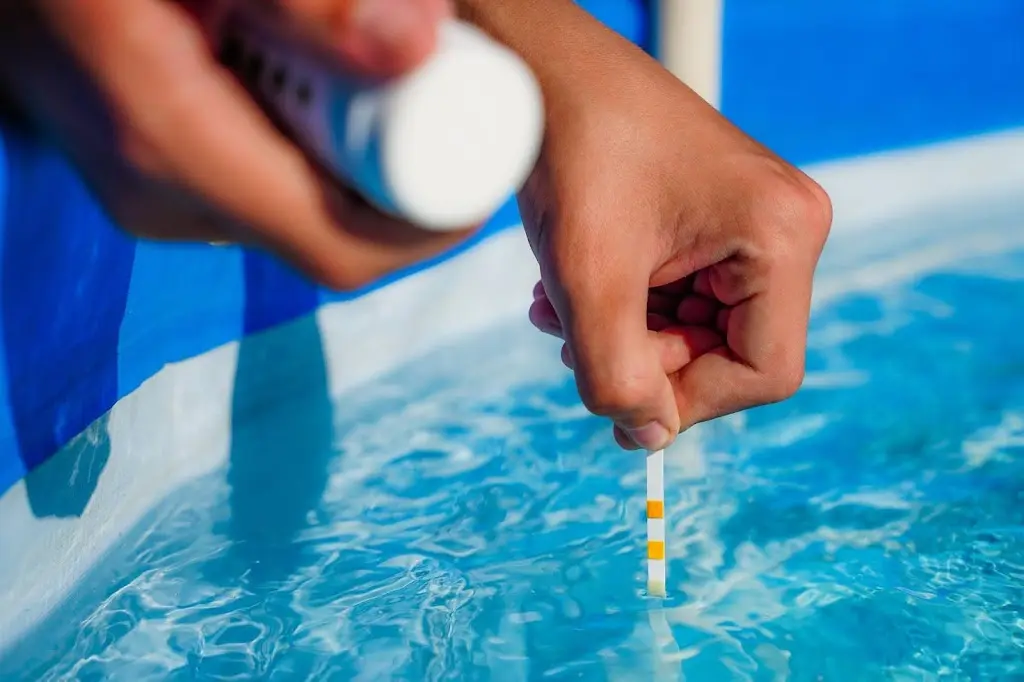
Interpreting Chlorine Readings: Limits, Ideal Ranges, Fixes
After selecting an appropriate testing method, the next step is interpreting results against regulatory limits, recommended ranges for different uses, and practical corrective actions.
Results are compared to legal maximums (e.g., drinking water residuals often 4 mg/L) and to ideal operational bands: potable supply typically 0.2–1.0 mg/L, pools 1.0–3.0 mg/L, and some industrial systems lower or higher per function.
Free chlorine versus combined chlorine readings guide decisions: low free chlorine implies insufficient disinfection; high combined chlorine signals chloramines and a need for breakpoint chlorination or flushing.
Corrective responses include dose adjustment, shock treatment, aeration, or targeted filtration.
Interpretations prioritize safety, regulatory compliance, and user preference for minimal chemical taste or odor while preserving freedom of system choice.
Chlorine Testing Plans: Frequency, Records, Corrective Actions
Because maintaining consistent disinfectant levels prevents health risks and regulatory breaches, a structured testing plan defines testing frequency, recordkeeping, and triggers for corrective action. Testing intervals balance risk, usage, and system complexity: high-demand or vulnerable systems require continuous or daily checks, while stable networks may use weekly or event-based sampling.
Records must be concise, timestamped, and accessible, documenting readings, methods, personnel, and calibrations to support audits and autonomous decision-making. Defined corrective thresholds prompt immediate steps—flush, shock, recalibrate feeders, or notify authorities—while escalation paths protect public access and choice.
Periodic review of plans, informed by data trends and stakeholder input, preserves operational freedom by minimizing unnecessary constraints and ensuring reliable, minimally invasive interventions.
Conclusion
Chlorine testing remains a fundamental element of water quality control, ensuring disinfection efficacy and public safety. Regular monitoring of free and total chlorine using appropriate methods—strips, kits, colorimeters, or sensors—allows operators to interpret readings, maintain ideal ranges, and implement corrective actions when limits are breached. A structured testing plan with defined frequency, accurate records, and prompt responses minimizes health risks and regulatory noncompliance, preserving trust in water systems and safeguarding communities.


